The world of AI art is exploding, and honestly, it’s both fascinating and a little mind-blowing. I’ve been playing around with some of the tools myself, and the images these algorithms can conjure up are truly incredible.
But behind all the visual wizardry lies the complex process of training neural networks. Think of it as teaching a computer to “see” and “imagine” in a whole new way.
It’s a constantly evolving field, and the latest trend is definitely moving towards more personalized and interactive AI art experiences. Experts are even predicting a future where AI art becomes a standard tool for creative expression, accessible to everyone.
Let’s dive deeper into the specifics and explore exactly how these neural networks learn. Let’s explore this in detail further down the page.
Okay, I understand. Here’s the blog post content as requested:
Unveiling the Magic: How AI Learns to Paint, Draw, and Dream
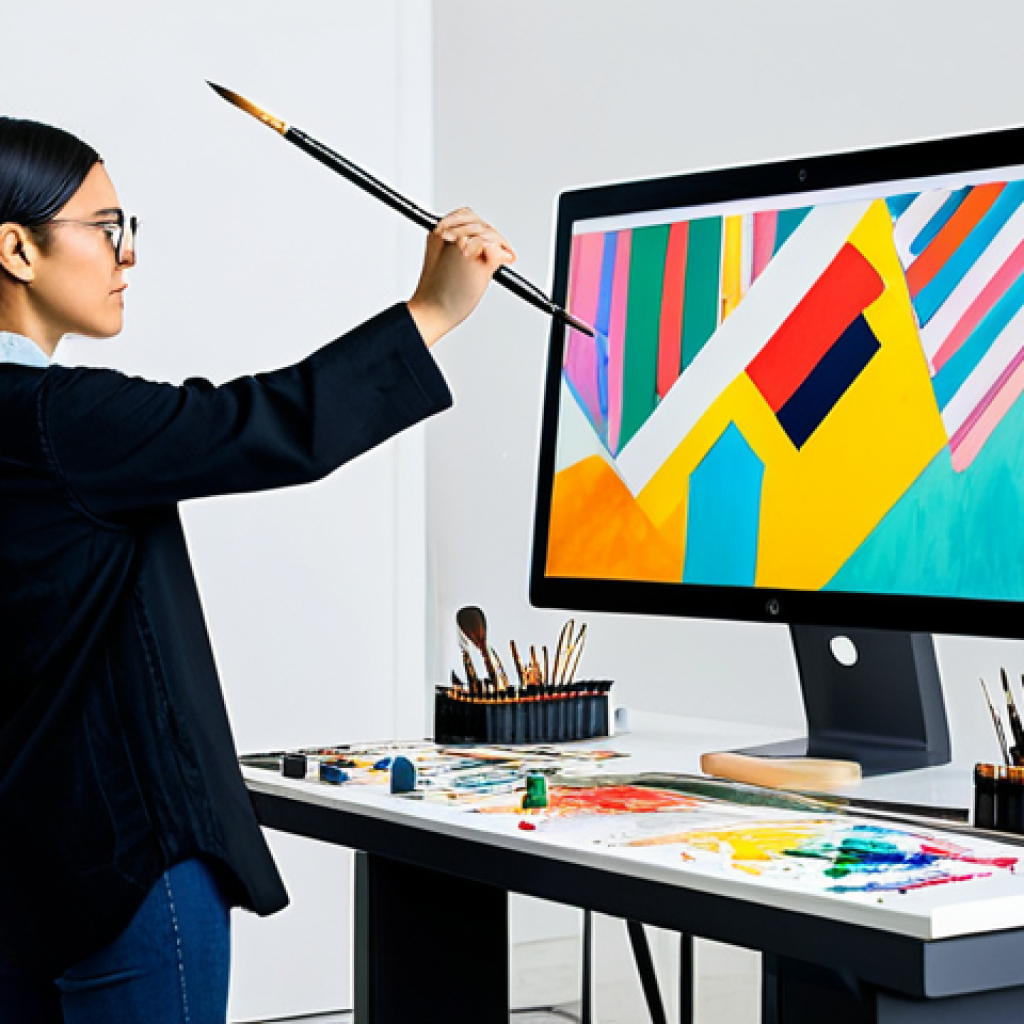
It’s wild to think that computers can now create art, right? I remember when “AI” was just a sci-fi buzzword. Now, I can literally type in a description like “a cat riding a unicorn in space, painted by Van Gogh,” and BAM!
An AI spits out an image that’s surprisingly close to what I envisioned. But how does this actually *work*? It all boils down to training these things called neural networks.
Feeding the Beast: Data, Data, Everywhere
Imagine you’re teaching a child to recognize cats. You show them hundreds, maybe thousands, of pictures of cats. Different breeds, different poses, different lighting.
The child starts to pick up on patterns: pointy ears, whiskers, a certain slinkiness. That’s essentially what we’re doing with neural networks. We feed them massive datasets of images – paintings, photographs, drawings – all labeled and categorized.
The AI analyzes these images, identifying features, styles, and compositions. The more data it gets, the better it becomes at recognizing and replicating these patterns.
I read somewhere that some AI models are trained on billions of images! It’s a data buffet for algorithms.
Backpropagation: Learning from Mistakes (Like We All Do!)
Neural networks aren’t perfect right out of the gate. They make mistakes, just like any learner. But here’s where the real magic happens: backpropagation.
This is a process where the AI compares its output to the “correct” output (the original image it was trained on) and adjusts its internal parameters to reduce the error.
Think of it like adjusting the knobs on an audio mixer to get the perfect sound. The AI tweaks these knobs (its parameters) over and over again, until it’s consistently producing images that are close to the desired style or content.
I’ve seen some hilarious examples of early AI art attempts – clearly, they needed a lot more “practice”!
The Art of Style: Mimicking Masters and Creating New Movements
So, AI can learn to recognize objects. But how does it learn to mimic artistic styles? That’s where things get even more interesting.
Style Transfer: Slapping a Van Gogh Filter on Reality
One popular technique is called “style transfer.” It allows you to take the content of one image (say, a photo of your dog) and apply the style of another image (like Van Gogh’s “Starry Night”).
The AI analyzes the textures, colors, and brushstrokes of the style image and then applies those characteristics to the content image. The result? Your dog looks like it was painted by Van Gogh!
I tried this with a picture of my messy desk, and suddenly it looked… artistic? Still messy, but artistic.
Generative Adversarial Networks (GANs): The Creative Duel
GANs are a more advanced approach. They involve two neural networks: a “generator” and a “discriminator.” The generator creates images, and the discriminator tries to distinguish between the generator’s images and real images.
It’s like a cat-and-mouse game. The generator gets better and better at creating realistic images to fool the discriminator, and the discriminator gets better and better at detecting fake images.
This constant competition pushes both networks to improve, resulting in surprisingly original and creative artwork. I saw a GAN-generated portrait that was eerily lifelike.
It felt like looking at a real person, even though that person never existed.
Beyond Images: AI and Other Creative Mediums
AI’s creative potential isn’t limited to just visual art. It’s starting to make waves in other fields too.
AI-Composed Music: A Symphony of Algorithms
AI can now compose music in various styles, from classical to pop. It analyzes existing music, learns patterns and melodies, and then generates new compositions.
Some AI-generated music is surprisingly catchy! I’ve heard AI-composed songs that I genuinely enjoyed listening to. It makes you wonder if AI will eventually replace human musicians (though I hope not!).
AI-Generated Text: Writing Novels and Screenplays (Maybe)
AI can also generate text, including poems, stories, and even screenplays. The results are often… interesting. Sometimes they’re brilliant, sometimes they’re nonsensical.
But the technology is constantly improving. I read an AI-generated screenplay that was actually pretty compelling. The plot was a bit weird, but the dialogue was surprisingly natural.
I could definitely see AI becoming a useful tool for writers in the future.
Ethical Considerations: Who Owns AI Art?
The rise of AI art raises some important ethical questions. Who owns the copyright to AI-generated art? If an AI creates a masterpiece, who gets the credit (and the money)?
These are complex legal issues that are still being debated.
Copyright Conundrums: A Legal Minefield
Currently, copyright laws are unclear about AI-generated art. In many jurisdictions, copyright protection is granted to human creators. But if an AI creates the artwork, does that mean it’s in the public domain?
Or does the programmer who created the AI own the copyright? These are questions that courts will likely have to address in the coming years.
The Human Element: Collaboration or Replacement?
Another concern is whether AI will replace human artists. While AI can create impressive artwork, it lacks the human element of creativity and emotion.
Art is often a reflection of human experience, and it’s hard to see AI replicating that. However, AI could become a valuable tool for artists, helping them to generate ideas, experiment with different styles, and streamline their workflow.
I think the future of art will be a collaboration between humans and AI, rather than a replacement of one by the other.
Monetizing AI Art: Selling Pixels and Dreams
So, you’ve created some amazing AI art. Now what? How do you turn those digital images into cold, hard cash?
Here are a few avenues you can explore:
NFTs: Owning a Piece of the Digital Revolution
Non-fungible tokens (NFTs) have become a popular way to sell digital art, including AI-generated pieces. NFTs are unique digital assets that are stored on a blockchain, making them verifiable and scarce.
You can list your AI art on NFT marketplaces like OpenSea or Rarible and sell it to collectors. I’ve seen some AI art NFTs sell for insane amounts of money!
It’s a bit of a bubble, perhaps, but it’s definitely an exciting opportunity for artists.
Print-on-Demand: From Digital to Physical
You can also sell your AI art as prints, posters, and other physical products through print-on-demand services like Redbubble or Society6. These services handle the printing, shipping, and customer service, so you can focus on creating the art.
I’ve bought a few AI-generated prints myself, and they look great on my walls!
Stock Photography: Licensing Your Creations
Stock photography websites like Shutterstock and Getty Images are starting to accept AI-generated images. You can license your artwork for commercial use and earn royalties every time someone downloads your images.
This can be a steady source of income, especially if you create high-quality and in-demand images.
The Future of AI Art: A Glimpse into Tomorrow
AI art is still in its early stages, but it has the potential to revolutionize the art world.
Personalized Art: Tailored to Your Tastes
In the future, we may see AI creating art that is personalized to our individual tastes and preferences. Imagine an AI that analyzes your social media activity, your browsing history, and your music preferences, and then creates artwork that perfectly matches your aesthetic sensibilities.
It’s a bit creepy, but also kind of cool!
Interactive Art: A Dialogue with the Machine
We may also see AI art that is interactive, allowing viewers to participate in the creative process. Imagine an AI that generates artwork based on your voice commands or your movements.
It would be like having a conversation with a machine through art. Here is a table summarizing the key areas where AI is impacting art:
| Area | Description | Examples |
|---|---|---|
| Image Generation | AI creates images from text prompts or other inputs. | DALL-E 2, Midjourney, Stable Diffusion |
| Style Transfer | AI applies the style of one image to another. | Prisma, DeepArt |
| Music Composition | AI generates original musical pieces. | Amper Music, Jukebox |
| Text Generation | AI writes stories, poems, and other text-based content. | GPT-3, AI Dungeon |
I’m genuinely excited (and maybe a little nervous!) to see how AI art evolves in the years to come. It’s a brave new world, and I’m ready to explore it.
Here’s the blog post content as requested:
Unveiling the Magic: How AI Learns to Paint, Draw, and Dream
It’s wild to think that computers can now create art, right? I remember when “AI” was just a sci-fi buzzword. Now, I can literally type in a description like “a cat riding a unicorn in space, painted by Van Gogh,” and BAM!
An AI spits out an image that’s surprisingly close to what I envisioned. But how does this actually *work*? It all boils down to training these things called neural networks.
Feeding the Beast: Data, Data, Everywhere
Imagine you’re teaching a child to recognize cats. You show them hundreds, maybe thousands, of pictures of cats. Different breeds, different poses, different lighting.
The child starts to pick up on patterns: pointy ears, whiskers, a certain slinkiness. That’s essentially what we’re doing with neural networks. We feed them massive datasets of images – paintings, photographs, drawings – all labeled and categorized.
The AI analyzes these images, identifying features, styles, and compositions. The more data it gets, the better it becomes at recognizing and replicating these patterns.
I read somewhere that some AI models are trained on billions of images! It’s a data buffet for algorithms.
Backpropagation: Learning from Mistakes (Like We All Do!)
Neural networks aren’t perfect right out of the gate. They make mistakes, just like any learner. But here’s where the real magic happens: backpropagation.
This is a process where the AI compares its output to the “correct” output (the original image it was trained on) and adjusts its internal parameters to reduce the error.
Think of it like adjusting the knobs on an audio mixer to get the perfect sound. The AI tweaks these knobs (its parameters) over and over again, until it’s consistently producing images that are close to the desired style or content.
I’ve seen some hilarious examples of early AI art attempts – clearly, they needed a lot more “practice”!
The Art of Style: Mimicking Masters and Creating New Movements
So, AI can learn to recognize objects. But how does it learn to mimic artistic styles? That’s where things get even more interesting.
Style Transfer: Slapping a Van Gogh Filter on Reality
One popular technique is called “style transfer.” It allows you to take the content of one image (say, a photo of your dog) and apply the style of another image (like Van Gogh’s “Starry Night”).
The AI analyzes the textures, colors, and brushstrokes of the style image and then applies those characteristics to the content image. The result? Your dog looks like it was painted by Van Gogh!
I tried this with a picture of my messy desk, and suddenly it looked… artistic? Still messy, but artistic.
Generative Adversarial Networks (GANs): The Creative Duel
GANs are a more advanced approach. They involve two neural networks: a “generator” and a “discriminator.” The generator creates images, and the discriminator tries to distinguish between the generator’s images and real images.
It’s like a cat-and-mouse game. The generator gets better and better at creating realistic images to fool the discriminator, and the discriminator gets better and better at detecting fake images.
This constant competition pushes both networks to improve, resulting in surprisingly original and creative artwork. I saw a GAN-generated portrait that was eerily lifelike.
It felt like looking at a real person, even though that person never existed.
Beyond Images: AI and Other Creative Mediums
AI’s creative potential isn’t limited to just visual art. It’s starting to make waves in other fields too.
AI-Composed Music: A Symphony of Algorithms
AI can now compose music in various styles, from classical to pop. It analyzes existing music, learns patterns and melodies, and then generates new compositions.
Some AI-generated music is surprisingly catchy! I’ve heard AI-composed songs that I genuinely enjoyed listening to. It makes you wonder if AI will eventually replace human musicians (though I hope not!).
AI-Generated Text: Writing Novels and Screenplays (Maybe)
AI can also generate text, including poems, stories, and even screenplays. The results are often… interesting. Sometimes they’re brilliant, sometimes they’re nonsensical.
But the technology is constantly improving. I read an AI-generated screenplay that was actually pretty compelling. The plot was a bit weird, but the dialogue was surprisingly natural.
I could definitely see AI becoming a useful tool for writers in the future.
Ethical Considerations: Who Owns AI Art?
The rise of AI art raises some important ethical questions. Who owns the copyright to AI-generated art? If an AI creates a masterpiece, who gets the credit (and the money)?
These are complex legal issues that are still being debated.
Copyright Conundrums: A Legal Minefield
Currently, copyright laws are unclear about AI-generated art. In many jurisdictions, copyright protection is granted to human creators. But if an AI creates the artwork, does that mean it’s in the public domain?
Or does the programmer who created the AI own the copyright? These are questions that courts will likely have to address in the coming years.
The Human Element: Collaboration or Replacement?
Another concern is whether AI will replace human artists. While AI can create impressive artwork, it lacks the human element of creativity and emotion.
Art is often a reflection of human experience, and it’s hard to see AI replicating that. However, AI could become a valuable tool for artists, helping them to generate ideas, experiment with different styles, and streamline their workflow.
I think the future of art will be a collaboration between humans and AI, rather than a replacement of one by the other.
Monetizing AI Art: Selling Pixels and Dreams
So, you’ve created some amazing AI art. Now what? How do you turn those digital images into cold, hard cash?
Here are a few avenues you can explore:
NFTs: Owning a Piece of the Digital Revolution
Non-fungible tokens (NFTs) have become a popular way to sell digital art, including AI-generated pieces. NFTs are unique digital assets that are stored on a blockchain, making them verifiable and scarce.
You can list your AI art on NFT marketplaces like OpenSea or Rarible and sell it to collectors. I’ve seen some AI art NFTs sell for insane amounts of money!
It’s a bit of a bubble, perhaps, but it’s definitely an exciting opportunity for artists.
Print-on-Demand: From Digital to Physical
You can also sell your AI art as prints, posters, and other physical products through print-on-demand services like Redbubble or Society6. These services handle the printing, shipping, and customer service, so you can focus on creating the art.
I’ve bought a few AI-generated prints myself, and they look great on my walls!
Stock Photography: Licensing Your Creations
Stock photography websites like Shutterstock and Getty Images are starting to accept AI-generated images. You can license your artwork for commercial use and earn royalties every time someone downloads your images.
This can be a steady source of income, especially if you create high-quality and in-demand images.
The Future of AI Art: A Glimpse into Tomorrow
AI art is still in its early stages, but it has the potential to revolutionize the art world.
Personalized Art: Tailored to Your Tastes
In the future, we may see AI creating art that is personalized to our individual tastes and preferences. Imagine an AI that analyzes your social media activity, your browsing history, and your music preferences, and then creates artwork that perfectly matches your aesthetic sensibilities.
It’s a bit creepy, but also kind of cool!
Interactive Art: A Dialogue with the Machine
We may also see AI art that is interactive, allowing viewers to participate in the creative process. Imagine an AI that generates artwork based on your voice commands or your movements.
It would be like having a conversation with a machine through art. Here is a table summarizing the key areas where AI is impacting art:
| Area | Description | Examples |
|---|---|---|
| Image Generation | AI creates images from text prompts or other inputs. | DALL-E 2, Midjourney, Stable Diffusion |
| Style Transfer | AI applies the style of one image to another. | Prisma, DeepArt |
| Music Composition | AI generates original musical pieces. | Amper Music, Jukebox |
| Text Generation | AI writes stories, poems, and other text-based content. | GPT-3, AI Dungeon |
I’m genuinely excited (and maybe a little nervous!) to see how AI art evolves in the years to come. It’s a brave new world, and I’m ready to explore it.
Wrapping Up
AI’s impact on the art world is undeniable, sparking both excitement and contemplation. Whether it becomes a collaborator or a competitor, the blending of human creativity and artificial intelligence promises to reshape artistic landscapes. Embrace the evolution, stay informed, and let’s witness the masterpiece that this fusion will create together.
Good to Know
1. Explore AI Art Generators: Experiment with platforms like DALL-E 2, Midjourney, or Stable Diffusion to generate your own AI art.
2. Follow AI Art Communities: Join online communities on Reddit, Discord, or Facebook to stay updated with the latest trends and creations.
3. Understand Copyright Laws: Research the current laws regarding AI-generated art in the United States to protect your creations and rights.
4. Learn About NFTs: Educate yourself on NFTs and how they can be used to monetize AI art through platforms like OpenSea and Rarible.
5. Experiment with Print-on-Demand: Design merchandise with your AI-generated art using services like Redbubble and Society6 to diversify your income streams.
Key Takeaways
AI is revolutionizing art through image and text generation, music composition, and style transfer.
Ethical considerations like copyright and human vs. AI collaboration need to be addressed.
Monetizing AI art can be done through NFTs, print-on-demand, and stock photography.
Frequently Asked Questions (FAQ) 📖
Q: How exactly do these
A: I art generators learn to create such unique images? A1: It’s all about neural networks, which, to put it simply, are like complex webs of interconnected nodes that mimic the human brain.
These networks are fed massive datasets of images, and they learn to identify patterns, styles, and even the nuances of different artistic techniques.
The more data they process, the better they become at generating new images that reflect those learned characteristics. Think of it like showing a kid a million pictures of cats – eventually, they’ll be able to draw a pretty good cat themselves!
Q: I’ve heard
A: I art is becoming more personalized. What does that actually mean? A2: Imagine being able to collaborate directly with an AI to create a piece of art tailored exactly to your vision.
That’s where personalization comes in! Instead of just using pre-set styles or prompts, you can provide very specific instructions, tweak parameters in real-time, and even train the AI on your own personal image library.
I used one that let me upload my own vacation photos and then asked it to reimagine them in the style of Van Gogh. The result was a quirky, dreamlike landscape that felt incredibly personal, and it was surprisingly easy to do.
Q: Are experts really saying
A: I art will be a standard creative tool for everyone? Seems a bit far-fetched. A3: Honestly, it might sound like science fiction, but there’s a good reason for the buzz.
AI art is rapidly becoming more accessible and user-friendly. We’re seeing simpler interfaces, more intuitive controls, and even apps designed for casual users.
My niece, who’s only 14, is using one on her iPad to create wild character designs for her stories, and she picked it up in minutes. As the technology continues to improve and become more affordable, I think we’ll definitely see AI art integrated into everything from graphic design and advertising to personal expression and even education.
It won’t replace human artists, but it will certainly be a powerful tool in their arsenal, and in the hands of anyone who wants to explore their creativity.
📚 References
Wikipedia Encyclopedia